
Virtual IOP for anxiety & depression in Colorado: 9 or more hours a week of CBT, DBT skills and group therapy by telehealth, with medication management.
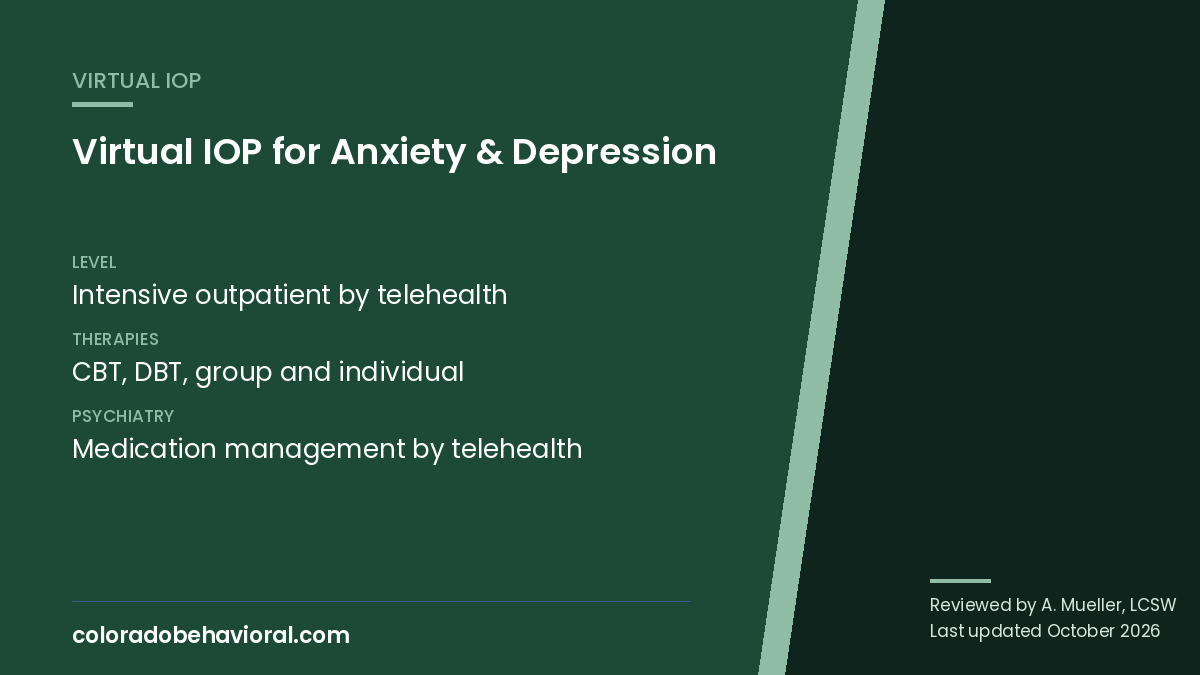
When worry or low mood has taken over most days and a weekly appointment is not enough, there is a level of care between therapy and the hospital. A virtual IOP for anxiety & depression gives adults in Colorado 9 or more hours a week of structured treatment by secure video, with cognitive behavioral therapy, DBT skills, group support and medication management, while you stay at home and at work.
IOP stands for intensive outpatient program. It is a defined level of care that sits between standard weekly therapy and partial hospitalization. The American Society of Addiction Medicine labels it Level 2.1, and SAMHSA’s treatment protocol on intensive outpatient treatment[1] describes it as 9 or more hours of structured programming a week, usually spread over 3 to 5 days, with partial hospitalization starting at 20 hours a week. Mental health programs use the same structure.
A virtual IOP delivers those hours by video: live group therapy, individual sessions with your clinician, and telehealth psychiatry when medication is part of your plan. You need a private space and a device with a camera, anywhere in Colorado.
Both conditions are common. National Institute of Mental Health estimates[2] put any anxiety disorder at 19.1 percent of U.S. adults in a given year and 31.1 percent over a lifetime. Colorado depression figures are in the next section.
Standard outpatient care works for many people. IOP is the right level when symptoms are heavier than one hour a week can carry but you do not need round-the-clock care. Signs that point to IOP include:
The Colorado numbers are large. SAMHSA’s 2023 to 2024 state tables[3] estimate that 26.36 percent of Colorado adults had any mental illness in the past year, 9.58 percent had a major depressive episode, and 10.94 percent had a co-occurring substance use disorder and mental illness. A virtual IOP for anxiety & depression is built for adults 18 and older who fit this picture and can take part from a stable home.
Your schedule is set at intake: 3 to 4 days a week, about 3 hours a day, in daytime or evening blocks. Each week includes:
Our clinical team uses CBT, DBT skills, trauma-informed therapy and motivational interviewing. Cameras stay on, and you take part. A virtual IOP for anxiety & depression is active treatment, not a video to watch.
Cognitive behavioral therapy is the core of the program. According to NIMH[4], CBT helps people notice automatic thoughts that are inaccurate or harmful, question them, and change self-defeating behavior patterns; it is well studied and considered the gold standard psychotherapy for generalized anxiety. For depression, the same approach targets the thinking and withdrawal that keep mood low.
DBT adds a skills layer. Cleveland Clinic[5] describes dialectical behavior therapy as CBT adapted for people who feel emotions very intensely, with four core skills: mindfulness, distress tolerance, interpersonal effectiveness and emotion regulation. It lists depression, anxiety and substance use disorder among the conditions DBT has been shown to help.
Medication is optional and is decided with you. If an evaluation suggests it would help, a telehealth psychiatry visit is added to your plan. The most commonly prescribed medications for both conditions are antidepressants, mainly selective serotonin reuptake inhibitors (SSRIs) and serotonin-norepinephrine reuptake inhibitors (SNRIs). NIMH notes[4] that these medications treat depression and can also ease anxiety, and that they may take several weeks to start working. Because IOP runs several weeks, your prescriber can watch that window and adjust. We coordinate with any outside prescriber you already see.
Many people with anxiety or depression also drink or use substances to cope, and the two problems feed each other. A virtual IOP for anxiety & depression at Colorado Behavioral Health treats both at once. Groups cover cravings and triggers alongside mood and anxiety skills, and telehealth psychiatry can coordinate medication-assisted treatment when indicated. If you are physically dependent on alcohol or benzodiazepines, admissions helps you arrange medical withdrawal management before IOP begins. Our addiction programs page describes the substance-specific tracks.
Levels of care are hours of structure per week. Standard outpatient is usually one to three hours. IOP is 9 or more. Partial hospitalization is 20 or more. Inpatient care adds a bed and round-the-clock staff.
Step down. When symptoms have eased and you are using your skills, you move to standard outpatient treatment with the same clinicians at fewer hours, or back to your own therapist.
Step up. If symptoms worsen despite IOP, if you are not safe at home, or if you cannot take part in sessions, our team helps you find a partial hospitalization or inpatient program. We do not provide those levels, and we refer rather than keep anyone at the wrong one.
Our virtual IOP in Colorado overview explains the full program. Condition pages for anxiety treatment in Colorado and depression treatment in Colorado cover each diagnosis across every level we offer, and the mental health hub lists the rest.
Starting takes three steps. First, a short call with admissions at (888) 604-8485, answered 24 hours a day, 365 days a year. Second, a benefits check: we verify your out-of-network benefits before your first session and explain costs up front, and you can start that on our verify insurance page. Third, a telehealth assessment, where a clinician confirms that a virtual IOP for anxiety & depression is the right level and sets your schedule.
For the assessment and your first group, have ready:
Intensive outpatient programs serve people with substance use disorders, including co-occurring mental and substance use disorders, who do not require medical detoxification or 24-hour supervision. They are designed as alternatives to inpatient and residential treatment that build psychosocial supports, relapse management and coping strategies.
A review of intensive outpatient programs published in Psychiatric Services by McCarty and colleagues in 2014[6] assessed the evidence across 12 individual studies and one review published between 1995 and 2012. Based on the quality of trials, diversity of settings and consistency of outcomes, the authors rated the level of evidence for intensive outpatient programs as high. Randomized trials and naturalistic analyses that compared intensive outpatient programs with inpatient or residential treatment found comparable outcomes. The authors concluded that intensive outpatient programs are as effective as inpatient treatment for most individuals.
That review covered substance use programs, including people with co-occurring mental disorders. Mental health IOPs share the same structure and core therapies. No program can promise a result.
The clearest sign is that weekly therapy, medication or both are not holding and symptoms are affecting work, school, sleep or relationships most days. A telehealth assessment settles the question. If weekly care is enough, we will say so.
Yes. With your permission, our clinicians coordinate with outside providers so medication and treatment plans line up. Many people return to their regular therapist after IOP.
No. Medication is offered when a telehealth psychiatry evaluation suggests it would help, and the decision is yours. Therapy is the core of the program with or without medication.
The first session can feel strange, especially with social anxiety. Groups are small and led by a licensed clinician who sets the pace. Most people settle in within the first week, and practicing in group is part of the treatment.
Tell admissions. Anxiety, depression and substance use are treated together in the same program. If withdrawal risk is present, we help you arrange medical care first and hold your start date.
Colorado Behavioral Health is licensed in Colorado and accredited by The Joint Commission. We provide virtual IOP and standard outpatient treatment for adults anywhere in the state, with telehealth psychiatry for medication management. When you call (888) 604-8485 or send the form, you speak with admissions for a few minutes. We verify your out-of-network benefits and explain costs up front. A clinician then completes a telehealth assessment, confirms the level of care, and gives you a start date. Talk to admissions.
Reviewed by Alyssa Mueller, LCSW, Licensed Clinical Social Worker, Colorado Behavioral Health. Last updated October 2026.
Every factual claim on this page is linked to a primary source. Numbered references in the text correspond to the list below.
Share a few details and our admissions team will call you back with your benefits, coverage, and a no-obligation recommendation for next steps.
"*" indicates required fields
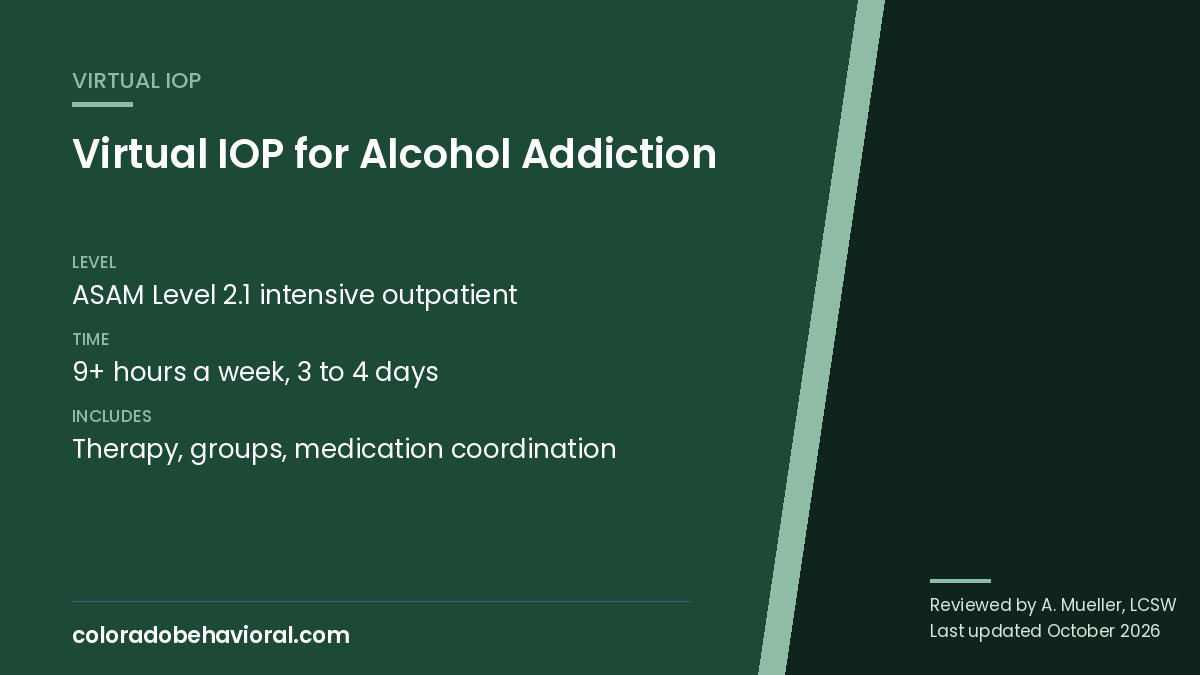
Comprehensive alcohol addiction treatment through a secure online platform — clinical-grade care that fits your schedule.

Discreet, flexible treatment built around demanding careers — structured care that fits a working week without disrupting your life.

Mood stabilization through medication, therapy, and structured support — helping individuals manage symptoms and maintain long-term stability.

Trauma-informed therapies help the brain process traumatic memories, regulate stress responses, and restore a sense of safety and emotional stability.
Multiple weekly therapy sessions through secure telehealth — evidence-based treatment while you live at home and stay connected.

Integrated, evidence-based treatment for alcohol use disorder — addressing medical complications and supporting sustained recovery.

Specialized clinical approaches addressing synthetic opioid dependence — built for the realities of today’s overdose crisis.

Comprehensive addiction and mental health treatment via secure, HIPAA-compliant telehealth — no geographic barriers, full clinical depth.
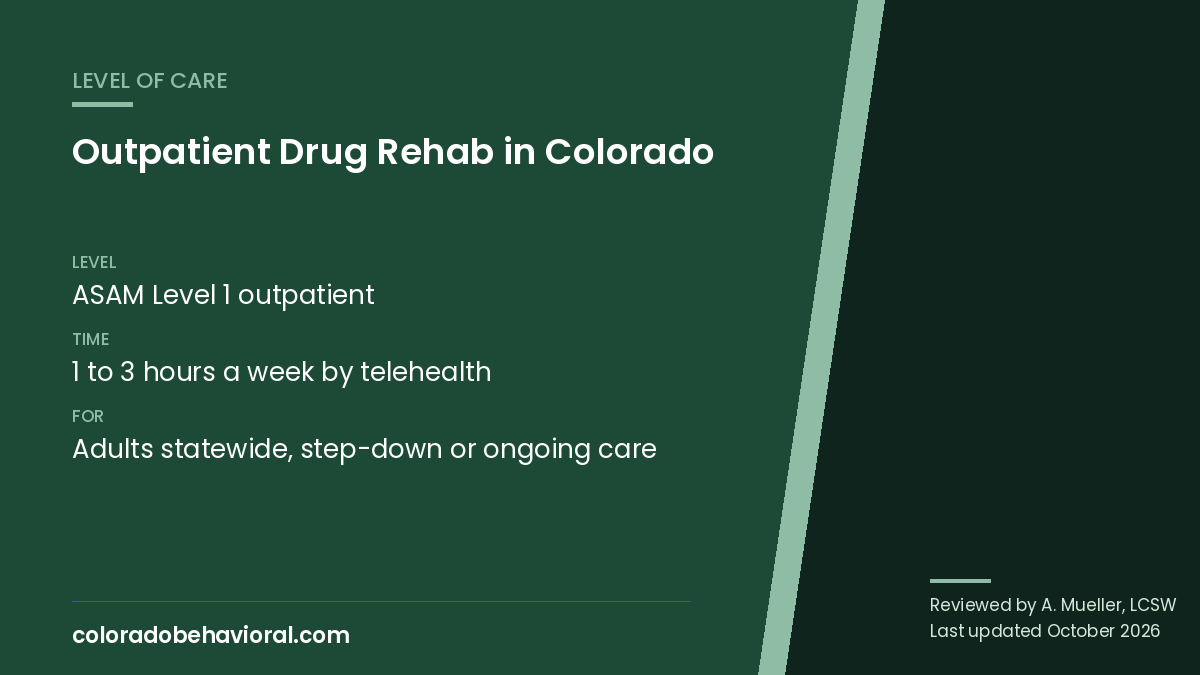
Flexible weekly therapy sessions to support long-term recovery while living at home.