
Outpatient drug rehab Colorado adults can keep up with: 1 to 3 hours a week of therapy by telehealth, psychiatry included. Joint Commission accredited.
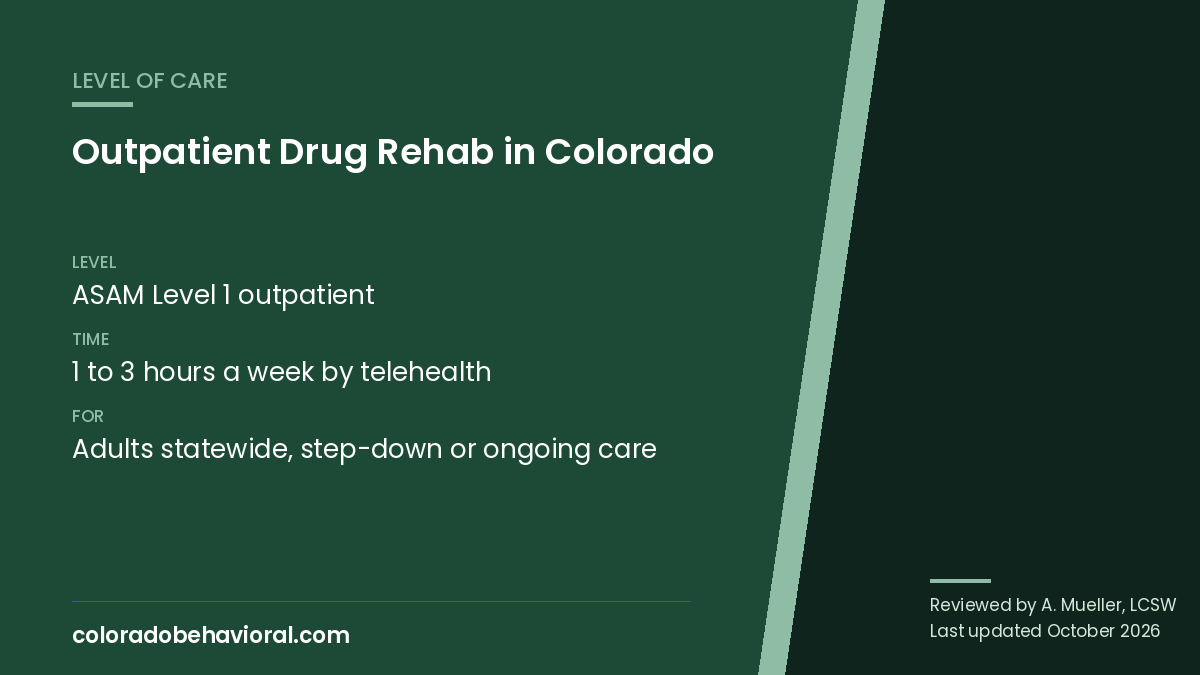
You want help with drugs or alcohol, and you also have a job, a family and a life that cannot stop for treatment. Standard outpatient treatment is the outpatient drug rehab Colorado adults choose when they need steady clinical support without 9 or more hours a week. Colorado Behavioral Health delivers it by secure video to adults 18 and older anywhere in Colorado: 1 to 3 hours per week of individual and group therapy, with medication management available through telehealth psychiatry. We are licensed in Colorado and accredited by The Joint Commission.
Addiction treatment is organized into levels of care. The American Society of Addiction Medicine (ASAM) publishes the criteria most programs use, and ASAM bases level of care recommendations on a multidimensional assessment[1] of a person’s medical, psychological and social needs across six dimensions. Standard outpatient treatment is Level 1, the least intensive level in which you still meet regularly with a licensed clinician.
The federal Substance Abuse and Mental Health Services Administration (SAMHSA) describes the difference in its Treatment Improvement Protocol on intensive outpatient treatment. SAMHSA’s TIP 47 reports outpatient programs providing 1 to 2 sessions a week of 1 to 2 hours each[2], and describes Level 1 outpatient services as the step down after intensive outpatient treatment. Intensive outpatient, by contrast, requires a minimum of 9 hours of service per week[3]. Our standard outpatient program sits in that Level 1 range, usually 1 to 3 hours weekly.
Standard outpatient treatment is a good fit when:
It is not the right starting point if you are using heavily every day, have had seizures or severe withdrawal in the past, or have had several recent overdoses. Then the clinical team recommends a higher level of care first and helps you get there.
A typical week of outpatient drug rehab Colorado clients attend with us includes:
That is the full weekly load, 1 to 3 hours, of the outpatient drug rehab Colorado residents can attend from any private space with a phone, tablet or laptop.
The main differences are hours and structure. Our virtual IOP in Colorado runs 9 to 12 hours per week, usually 3 or 4 group sessions of about 3 hours plus individual therapy, for 8 to 12 weeks. Standard outpatient treatment is the outpatient drug rehab Colorado clients most often step down to after IOP. It runs 1 to 3 hours a week and can continue for months, with the same team and platform following you down.
Above IOP are partial hospitalization (about 20 hours a week of clinical programming), residential treatment (living at a facility), and medically managed inpatient care, including detox. We do not provide those levels. If the assessment shows you need one, our clinical team says so plainly and helps you connect with a program, then welcomes you back when you are ready to step down.
Starting outpatient drug rehab Colorado adults can attend by telehealth takes three steps:
For the first session, have your photo ID, insurance card, a list of current medications and doses, the names of any other providers you see, and a private place with a charged device. If you are stepping down from another program, bring your discharge paperwork.
Treatment that lasts matters more than treatment that is intense for a short time. In a research review in Alcohol Research: Current Reviews, McKay found that continuing care for substance use disorder shows a positive effect in most studies[5], with stronger results when the duration is longer and the program makes more active efforts to keep patients engaged. In practice, the outpatient drug rehab Colorado adults attend after IOP is that continuing care phase: fewer hours, longer horizon, regular contact.
Delivery by video is also well studied. SAMHSA’s evidence-based guide on telehealth for substance use disorders[6] reviews how telehealth can deliver treatment to adults and turns the research into practice recommendations. Our program follows those recommendations, including a private-space check at the start of every session.
Most people stay 3 to 6 months, and some continue with less frequent sessions for a year or more. Length depends on your goals, your progress and what your clinician recommends. There is no fixed end date you have to hit.
It can be, if use is not daily, withdrawal is not a medical risk and you have a stable place to live. If you are using heavily every day, a telehealth assessment will likely point you to virtual IOP or a higher level of care first, and you can step down to outpatient later.
Yes. Telehealth psychiatry appointments are available for medication management and for coordinating medication for addiction treatment. Your therapist and prescriber share one treatment plan.
Yes. Our clinicians are licensed in Colorado, so you must be physically in the state during sessions. You can live anywhere from Denver to Durango and join from home, work or a parked car.
Not from us. We release information only with your written permission. Sessions can be scheduled in the early evening so you do not have to explain time away from work.
Admissions verifies your out-of-network benefits before your first session and tells you the expected cost in plain numbers. Outpatient care uses fewer hours than IOP, so it usually costs less per week.
Call (888) 604-8485 or send the form and you reach admissions, any hour, 365 days a year. Expect a short conversation about what is going on, a benefits check with costs explained up front, and a clinical assessment by telehealth with a licensed clinician. If standard outpatient treatment fits, you get a start date and a weekly schedule. If you need more support first, we point you to virtual IOP or a higher level of care. Related programs include alcohol addiction treatment, fentanyl addiction treatment, virtual IOP for working professionals and mental health treatment, and Denver residents can read about drug treatment in Denver. Talk to admissions.
Every factual claim on this page is linked to a primary source. Numbered references in the text correspond to the list below.
Reviewed by Alyssa Mueller, LCSW, Licensed Clinical Social Worker, Colorado Behavioral Health. Last updated October 2026.
Share a few details and our admissions team will call you back with your benefits, coverage, and a no-obligation recommendation for next steps.
"*" indicates required fields
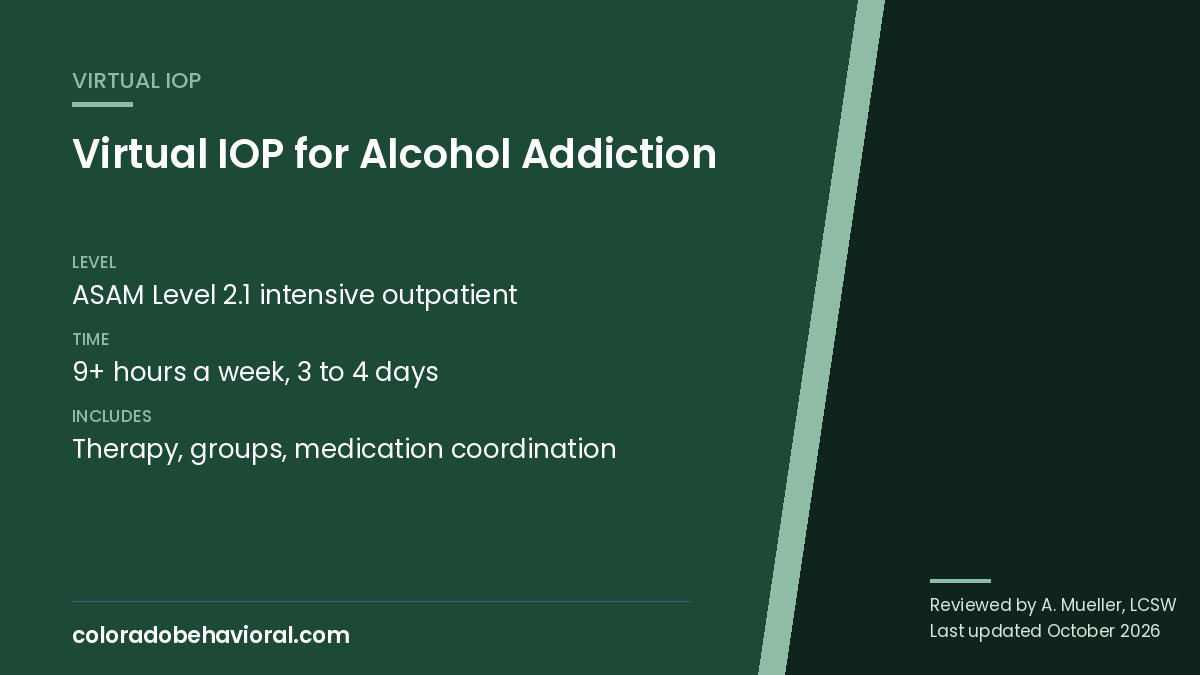
Comprehensive alcohol addiction treatment through a secure online platform — clinical-grade care that fits your schedule.

Discreet, flexible treatment built around demanding careers — structured care that fits a working week without disrupting your life.

Mood stabilization through medication, therapy, and structured support — helping individuals manage symptoms and maintain long-term stability.

Trauma-informed therapies help the brain process traumatic memories, regulate stress responses, and restore a sense of safety and emotional stability.
Multiple weekly therapy sessions through secure telehealth — evidence-based treatment while you live at home and stay connected.

Integrated, evidence-based treatment for alcohol use disorder — addressing medical complications and supporting sustained recovery.

Specialized clinical approaches addressing synthetic opioid dependence — built for the realities of today’s overdose crisis.
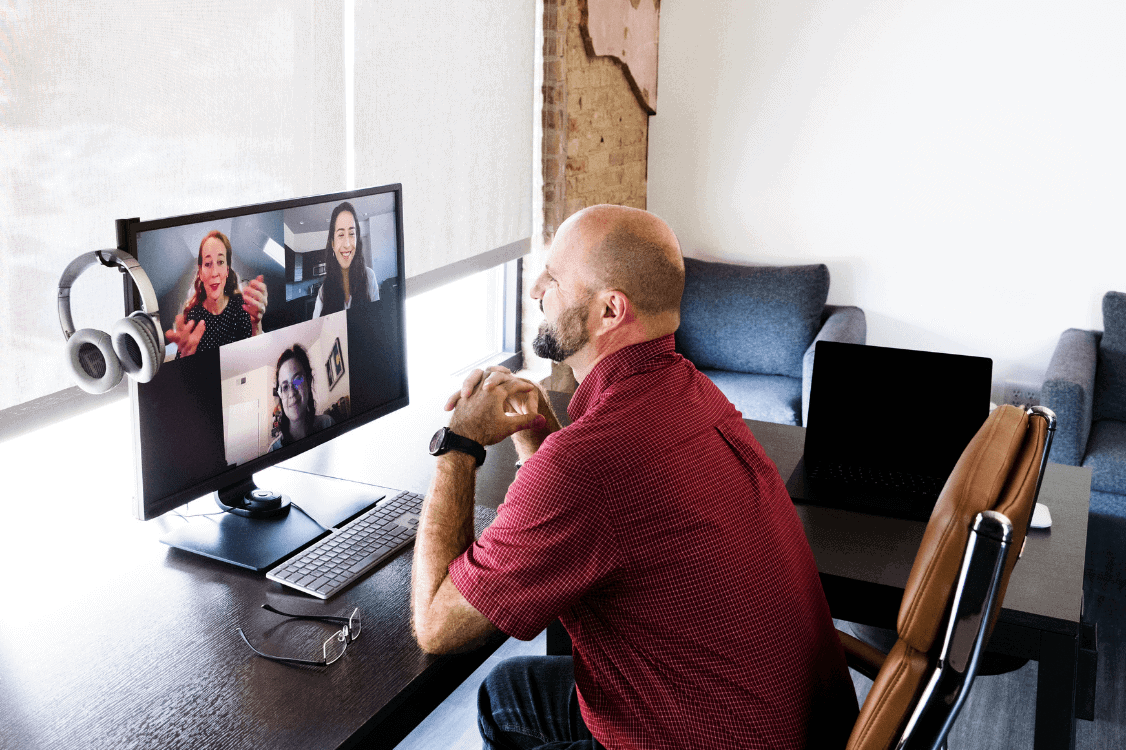
Comprehensive addiction and mental health treatment via secure, HIPAA-compliant telehealth — no geographic barriers, full clinical depth.
Flexible weekly therapy sessions to support long-term recovery while living at home.