If you live in Denver and drugs or alcohol have taken over more of your week than you want, you are not the only one looking for a way out. Colorado Behavioral Health provides drug treatment in Denver through a virtual intensive outpatient program (IOP) and standard outpatient care for adults 18 and older. Groups and individual sessions happen by secure video, from your home in Capitol Hill or Green Valley Ranch or a quiet room at work. We are licensed in Colorado and accredited by The Joint Commission.

Denver is the largest city in Colorado and the state capital. The Census Bureau estimates 740,613 residents as of July 1, 2025[1], up from a 2020 base of 715,509. The city’s own 2025 Community Report[2], using Census Bureau estimates, lists a median household income of $94,718, a median gross rent of $1,831, and a median home cost of $616,000. About 56.5 percent of adults hold a bachelor’s degree or higher, and 48.8 percent of households own their home.
Denver is a city of neighborhoods. Capitol Hill, Five Points, Highland, Baker, Park Hill, Montbello, Westwood and Green Valley Ranch each have their own rents and commutes. The City and County of Denver’s 2025 Disclosure Statement[3] reports that the three largest industry sectors in 2024 were professional and business services (22.9 percent), government (13.1 percent), and education and health services (11.9 percent). As the state capital, Denver has more than 74,000 federal, state and local government employees. Large private employers in the metro area include Amazon, Lockheed Martin and United Airlines, and the same report puts the city’s 2024 unemployment rate at 4.4 percent.
Commutes are a real constraint on care. The same Denver report cites a regional study that found commuters in the Denver-Aurora area lose 43 hours a year to traffic congestion. According to the city’s 2024 Consolidated Plan[4], 36 percent of Denver workers already spend 30 minutes or more getting to work each way. A drive to a clinic three or four evenings a week is often why people put off treatment. Virtual drug treatment in Denver removes that drive.
The federal Health Resources and Services Administration (HRSA) tracks where there are too few mental health providers for the population. Its FY 2025 fact sheet for Denver County[5] lists 10 mental health professional shortage designations as of September 30, 2025. Statewide, the HRSA fact sheet for Colorado[6] counts 78 mental health shortage designations. Even in a city with large health systems, people wait weeks for an intake or cannot find a program that fits around a job.
The need is not abstract. The Denver Department of Public Health and Environment reports, using Denver Office of the Medical Examiner data, that Denver recorded 483 drug overdose deaths in 2024 and 598 in 2023[7]. Preliminary 2025 counts stand at 562 deaths, with fentanyl noted in 376 and methamphetamine in 303. Since 2020, the city has lost 2,938 people to overdose. Treatment that starts quickly, and that you can keep attending, matters.
Our program runs on live video with Colorado-licensed clinicians. Here is what to expect as a Denver resident:
SAMHSA’s guide on telehealth for substance use disorders[9] reviews how video care can treat adults and turns that research into practice recommendations, which our virtual IOP follows.
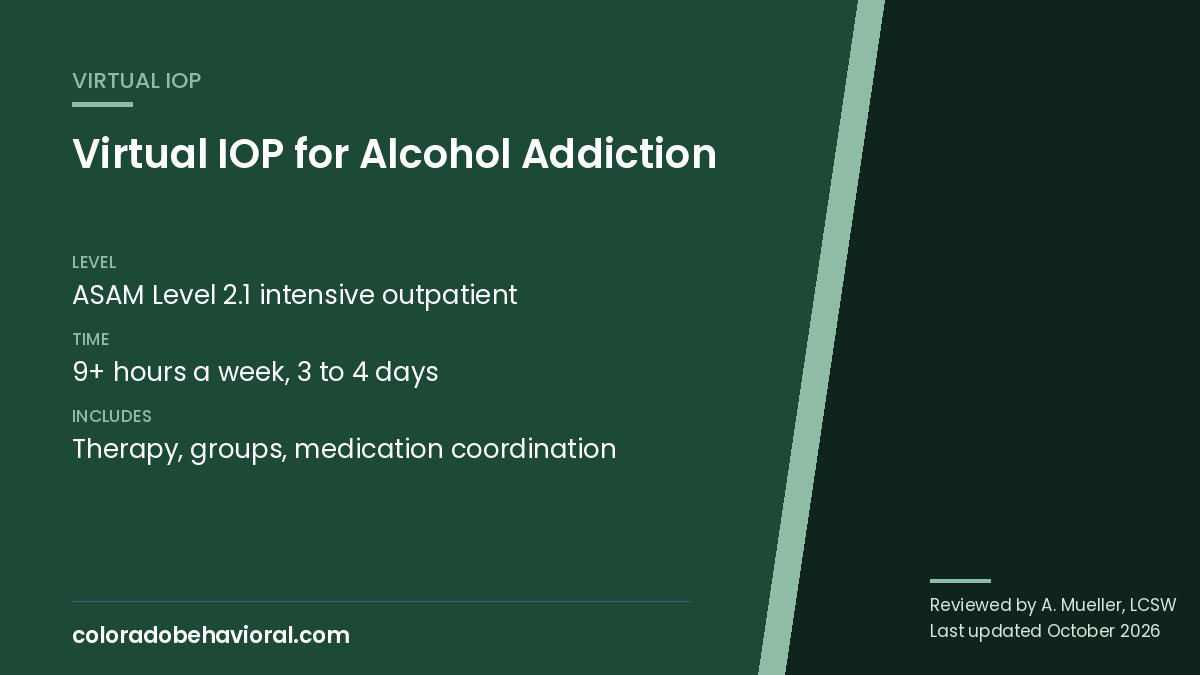
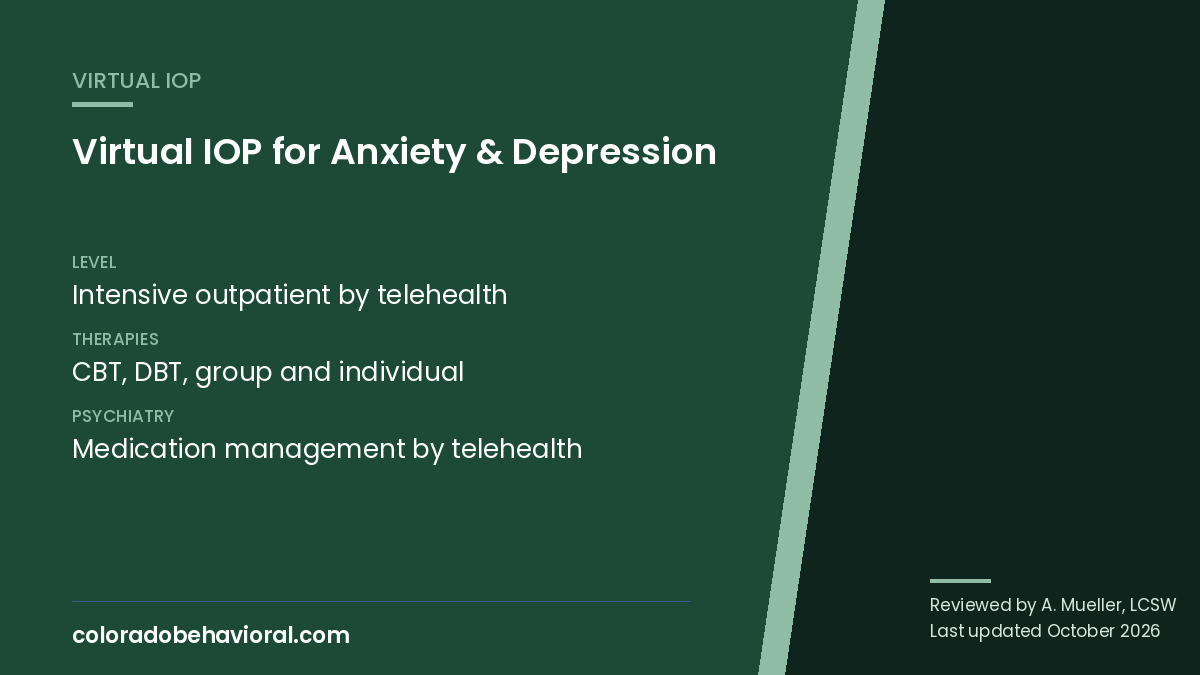
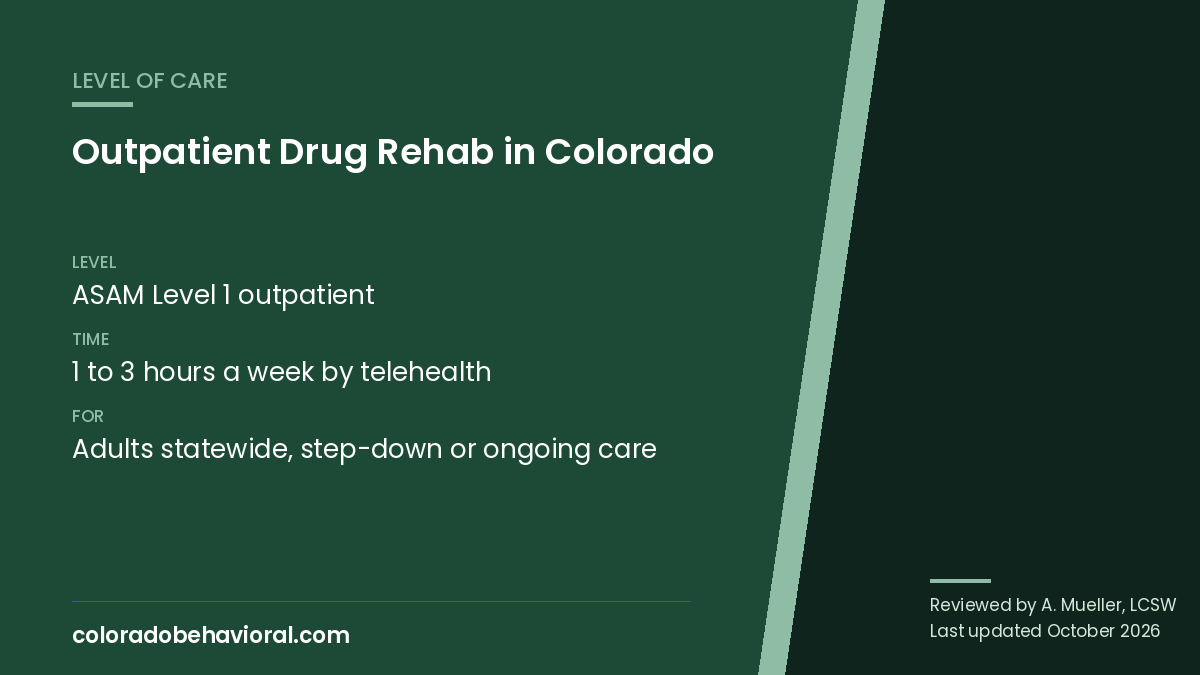
Every program below is delivered statewide by telehealth. Together they make up our drug treatment in Denver: one intensive track and one lighter track, both run by the same clinical team.
Admissions verifies your out-of-network benefits before your first session and explains what you will owe up front, in plain numbers, so the cost of drug treatment in Denver is clear before you commit. If you want to check coverage first, use the insurance verification form and we will call you back with the details.
No. You need to be an adult who is physically in Colorado during your sessions. Many clients live in Denver, Aurora, Lakewood, Englewood or farther out along the Front Range. Where you live in Colorado does not change the program.
Many people do. You need a private room, a device with a camera, and a stable connection. Evening groups are built for people who work days. If a shift changes, tell your clinician and the schedule can be adjusted.
The telehealth assessment looks at withdrawal risk, medical needs and safety. If you need detox, residential or partial hospitalization first, our clinical team says so and helps you connect with that level of care. When you are ready, you can step down to our virtual IOP.
1500 N Grant St, Ste N, Denver, CO 80203 is our service address in the Capitol Hill area. Treatment is delivered by telehealth, so you will not need to park downtown or sit in a waiting room. Admissions can explain how to reach us.
When you call (888) 604-8485 or send the form, you reach admissions. The line is answered 24 hours a day, 365 days a year. You will have a short conversation about what is going on, then we check your out-of-network benefits and explain costs. Next comes a clinical assessment by telehealth with a licensed clinician, who recommends virtual IOP, standard outpatient care, or a higher level of care if that is what you need. If our program fits, you get a start date and a group schedule that works with your life in Denver. Talk to admissions.
Every factual claim on this page is linked to a primary source. Numbered references in the text correspond to the list below.
Image credits: Denver skyline from Speer Blvd near I-25, April 2019 by Xnatedawgx, CC BY-SA 4.0, via Wikimedia Commons, https://commons.wikimedia.org/wiki/File:Denver_skyline_from_Speer_Blvd_near_I-25,_April_2019.jpg